What does it actually look like to walk away from a successful career and bet everything on self-storage…and win?
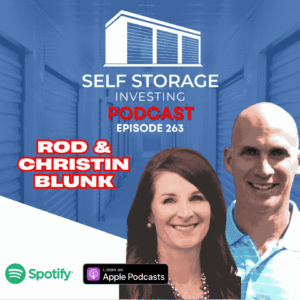
Joe Downs sits down with Christin and Rod Blunk, a husband-and-wife team who completed over 450 residential real estate transactions before pivoting to self-storage in 2020.
Fueled by a health crisis that revealed the fragility of active income, they got educated through the Self-Storage Academy, bought their first facility in Kentucky for $330,000, and have since grown it to nearly $800,000 in value…while cash flowing $20,000 a year net.
Their second acquisition, purchased for $430,000, is now worth $1–$1.1 million. Today, they own multiple facilities, hold LP positions, and are raising capital.
This is one of the most powerful W2-to-self-storage investing stories in the space.
Listen For:
6:19 Why did Christin and Rod Blunk leave residential real estate for self-storage investing?
14:19 How did the Blunks buy their first self-storage facility for less than a single-family home?
17:04 How did driving for dollars lead to a $430,000 self-storage deal worth over $1 million today?
23:33 How did Christin and Rod go from students at the mastermind to raising capital from investors?
30:34 What advice do Christin and Rod Blunk have for investors sitting on the fence about self-storage?
Leave a positive rating for this podcast with one click
CONNECT WITH GUEST: ROD & CHRISTIN BLUNK
Warriors 2 Wealth Website | Warriors 2 Wealth YouTube | Christin’s Instagram | Christin’s LinkedIn | Rod’s LinkedIn | Rod’s Instagram
CONNECT WITH US
Website | You Tube | Facebook | X | LinkedIn | Instagram
Belrose website | Belrose email | Belrose LinkedIn
Follow so you never miss a NEW episode! Leave us an honest rating and review on Apple or Spotify.
Attend the LAST Self Storage Academy of 2026
A 3-Day Live Implementation Event for Investors Ready to Execute
https://selfstorageacademy.com/https://selfstorageacademy.com/
Announcer (00:03):
This is the self Storage Podcast with the original self-storage expert, Scott Meyers.
Joe Downs (00:11):
Picture this. You’re sitting at the kitchen table, it’s 2012. You finally opened the statements, the 401k, the IRA, the mutual funds. The crash was four years ago. You’ve still been contributing every single month and you’re still not back to where you were before 2008. You did everything right. You didn’t panic sell, you stayed the course, you were the good investor. And four years later, you’re still treading water. Most people close the statement and go right back to doing the same thing because what else are you going to do? That’s what we’ve been told. Stay the course, trust the market. But a few people look at that number and something breaks. Not breaks as and falls apart, but breaks as in breaks free. They say, “This isn’t the path. It can’t be. There has to be a better way.” That kitchen table, that four years too late moment, that’s where empires start.
(00:58):
And that’s exactly the story of my guests today, Kristen and Rod Blanc. And what happened after that moment is one of the best W2 to self-storage stories I’ve ever had the privilege of watching up close. A husband and wife team, both former W2s, started a residential real estate company in 2012. And between 2012 and 2019, they completed over 450 transactions, buying, flipping, holding, wholesaling, all residential properties. In 2020, though, they took, in their words, a leap of faith and pivoted to self-storage. Now they own and operate multiple facilities, have development land, LP positions, and several others. I know my company, Belrose Storage Group, has partnered with them and I’ve watched them go from the back of the room at the mastermind to standing on stage at our academies. So this is personal for me. Kristen, Rod, welcome to the Self-Storage Investing Podcast. How are you today?
Christin Blunk (01:53):
Great, Joe. Thanks for having us on.
Rod Blunk (01:55):
Doing well. Thanks for having us.
Joe Downs (01:56):
All right. I hope you’re as excited as I am today.
Rod Blunk (01:59):
Of course.
Joe Downs (02:00):
I want you to take me back. You’re at that kitchen table in 2012. Walk us through what happened when you opened those statements and saw the numbers you saw. What went through your head? What were you feeling?
Christin Blunk (02:14):
Well, I was the one who opened the statements because I handled the financial piece of our household. And I was shocked because for four years, I didn’t open those statements as they came in because I thought we were young, we could recover. We were staying the course, like you said, for the last four years, contributing greatly each month. And when I opened it up, I was sick to my stomach because we were not where we were before 2008 hit. And we were still contributing for the last four years, not to mention the exorbitant amount of fees we were paying these brokers to manage our money. So it was kind of eye-opening and I realized that, wow, we thought we were doing everything right, but if we stayed the course, we weren’t going to be where we wanted to be. So Rod and I had a conversation and just didn’t know what we needed to do, but knew that there was a different path.
(03:05):
So just started educating ourselves and decided that we wanted to go into real estate. And so we opened up a residential real estate company.
Joe Downs (03:11):
Were you both on the same page or did one of you have to kind of pull the other along? Rod, I see you kind of smiling or about to crack a smile there, so maybe you want to take that one.
Rod Blunk (03:23):
So I was at still the W2 guy and I realized we needed to do something, but I was already busy. To me, I was still stuck in some of the mindset of the W2 of, “Hey, I got to do this. I got to pay for the family. I got to make sure the bills are there, but I’m behind you. Just go find out what you can find out and then tell me where we want to go and let’s see how it goes, but I need you to lead the way.” And she did. I mean, she truly did. Grabbed the bull by the horns and took off. I mean, she is office. So
Joe Downs (03:54):
You had a little bit of doubt maybe, is that fair to say?
Rod Blunk (03:58):
Oh yeah. I mean, how long have I been putting money in it like everybody else? Watch everybody else do it. Put money in it, put money in it. But the only body who’s making any money of it was the, like Kristen said, the brokers. They’re getting
Joe Downs (04:12):
All the money. Kristen, did you have a firm resolve that something had to change and a new direction was needed?
Christin Blunk (04:17):
Just opening those statements four years later, just politified that something had to change. All
Joe Downs (04:23):
Right. So you started looking into real estate. What was that search like? Were you looking at multifamily? Did you look at any other type of real estate? Was it just residential at first?
Christin Blunk (04:36):
In the beginning, it was residential. I felt like that was something that I could do, that I could manage. It just seemed doable to me. So we dove in, we started educating, reading lots of books, and Rod went to an auction and bought our first property without me bear. It was kind of scary.
Joe Downs (04:56):
Wait a second. Wait a second. You did all the work and research and you sent Rod to an auction and he comes home with property?
Christin Blunk (05:05):
It was a tax
Joe Downs (05:05):
Matter. Were you the only bidder?
Rod Blunk (05:08):
No. Oh, no.
Joe Downs (05:11):
Is this how I ended up with tickets to the WWE? Like, “Hey, I’ll start the bidding.” And then I was the only bidder?
Rod Blunk (05:18):
No, I was bidding against competition. I went to like 97,000. We ended up selling that property for 300 and something.
Joe Downs (05:26):
And you didn’t even know what you were doing yet?
Rod Blunk (05:28):
I knew that. I kind of estimated what the costs were going to be because I’ve done a lot of home improvement stuff and that’s kind of what gave us the confidence that we could do residential pretty easily.
Christin Blunk (05:40):
Yeah, we didn’t have any contractors lined up or anything, Joe. No. He came home with a property and I’m like, “Oh,
Joe Downs (05:48):
Okay.” Yeah, I feel like you guys are on the wrong podcast. You should be on a residential real estate podcast telling this story. That’s insane. All right. So you launch a residential company in 2012. You’re off to the races thanks to this blind auction that we just attended. 450 plus transactions in, that’s not even a side hustle, that’s a real business. So what happened next? Why are you here?
Christin Blunk (06:14):
Why am I here?
Joe Downs (06:14):
You seem like you’re crushing it. You’re crushing it in resi at that point.
Christin Blunk (06:19):
We were crushing it Resi. It was brutal. It was a lot of fun. We enjoyed doing it, but it was a lot of hustle. Money coming in, money coming out, deal junkies, always having to buy, always having to sell. And what happened to us is in 2016, Rod got diagnosed with cancer and we went through that. And there was a period of time, almost a year where he couldn’t work and he needed 24 hour care and I was his caretaker. So income wasn’t coming in from him and income wasn’t coming in from me. He was still a W2 and I was running the residential real estate company. We were able to survive that, but once Rod recovered, we realized that, wow, we could really go down this path again, knock on wood. Hopefully that never happens, but there’s only … If we do go down that road, there’s only a matter of time before all the money runs out.
(07:12):
And we wanted to put ourselves in a better position for us and for our girls. And so we started looking at other … First of all, I was stuck in residential real estate, so we had our goals. And then I sat down and did all the numbers in residential real estate and realized there was no way that I wanted to own that many properties to get to where we wanted to get to. And so we both decided that we would open our eyes and walk into asset classes. And so we expanded our mind into commercial. Self-storage, mobile home parks, RV parks. And anything else, Rod, that we looked at?
Rod Blunk (07:49):
No. Well, I thought about building athletic parks for people to go and work out and stuff like that probably two years before the fan, which would’ve been great, but we just didn’t pull the trigger.
Christin Blunk (08:03):
But our main goal was to have income coming in where I wasn’t trading our time for money and there was consistent income coming in case I had to be as caretaker and Rod also wasn’t able to work. And so we fell in love with self-storage because really, I say passive income, there’s an active piece to it for sure, but there’s steady income coming in every month and we are not trading nearly the time that we traded when we are in residential real estate and we’re making a lot more money as well. Yeah.
Rod Blunk (08:35):
And I just want to add one quick thing. We had one experience where it took us nine months to get a tenant out of one of our apartments. And I don’t ever … I mean, when I can do that in three months with self-storage, because the laws and how you don’t need to have your storage and stuff you have in storage, it’s not for you to live. It’s only extra and the laws know that versus, “Hey, I need a place to stay.” And they always support the renter, not the actual people paying the mortgage.
Joe Downs (09:09):
Okay. And you deal with … Where are we in this? So Rod’s sick and you’re caring for him and the income stops, right? That’s what I thought. So you said something that’s interesting that really stuck with me, and if you’re listening, it should have stuck with you. Chris, you said the storage isn’t passive income, right? But it’s consistent income without trading your time for dollars the same way residentials. So I think that’s interesting because when you live through your income going to zero because you can’t work, that distinction is no longer academic. It’s survival, right? So that’s wild. So gosh, we sit there and we think about these things, right? We plan them on paper or maybe in Excel or shoot, now we’re using AI to plan these things out, right? But are you doing it in a vacuum or real life? You actually did it in real life where things mattered because you did have to stop working to care for Rod.
(10:22):
And so you actually experienced it. That’s just so incredible. All right. So you’re coming out of this and you make the decision to shift into commercial assets. Self-storage specifically is where you kind of honed in on. Talk to me about that leap because you had to be very comfortable and residential. You knew the margins, you knew the game. What was it like stepping into something where you didn’t know how to own and operate? And in your case, I happen to know, and I know you’re going to tell this part of your story, but it wasn’t even in your backyard.
Christin Blunk (10:55):
So we did take a leap of faith. We were very comfortable with residential real estate, our skillset there. We knew how to do it. We knew how to make money. We knew it worked. And for the self-storage, we weren’t so sure. We never owned and operated. We never owned a commercial asset, didn’t know how to buy, didn’t know how to operate it. So we joined at the self-storage academy and educated ourselves to learn the skillsets that we needed to be able to purchase the facility and to be able to operate a facility. All of our residential, with the exception of a few of our rental properties, were all local to us. And so we were in the mindset that it needed to be in our backyard. And we live in Maryland, and I’m not sure if any people are aware, but most of the self-storage in Maryland are Class A facilities and our appetite wasn’t Class A.
(11:43):
There’s different Class A, Class B, Class B self-storage facilities. And we were looking at more of the value add mom and pop type facilities, and there weren’t that many in this area. And so we were kind of in our own way for the first year, thinking that we had to stay in our backyard. And fortunately, we were surrounded by a great community who helped us get out of our own way and show us the way that we could actually buy outside of our state and that we could actually operate it from Maryland when it’s in Kentucky or North Carolina or wherever the facility is. So we took the sleep of faith. Kind of the first one was to prove and test the waters. Does this really work? Can we really do this? And it did. And we were so confident that we were closing on our first facility.
(12:31):
We got under contract on our second facility and it’s five years later and I can tell you that it definitely works.
Joe Downs (12:40):
I want to rewind a second because as you’re telling this story, and it’s so fascinating, and I know I know some of it because I know you guys pretty well, but I don’t know all of it. And I want to ask a question here. So you got yourself educated through the self-storage academy. Did you do that in residential?
Christin Blunk (13:01):
Yes.
Joe Downs (13:01):
Or did you just send Rad to an auction and he came home with a property?
Christin Blunk (13:05):
Well, kind of both. I think he bought the property and then we’re like, oh crap, what would we do
Joe Downs (13:10):
With this? Maybe we should get education on this.
Christin Blunk (13:12):
We didn’t have a contractor. We didn’t have anything like this.
Rod Blunk (13:18):
No clue. I had a house. I had another house.
Christin Blunk (13:21):
Yeah. Joe, I never shared that story with you and it was with a pool nonetheless.
Rod Blunk (13:26):
This was our- Yes, it had a pool.
Christin Blunk (13:27):
A damn pool.
Joe Downs (13:29):
What could possibly go wrong here? So you bought this house with education, you said?
Christin Blunk (13:40):
We were in the process of educating ourselves. So we weren’t fully educated. We didn’t really know what we were doing. Rod thought he got a great deal.
Rod Blunk (13:51):
I did.
Christin Blunk (13:51):
He bought it.
Joe Downs (13:54):
Was it at the end of the day?
Announcer (13:56):
Are you? Yeah.
Joe Downs (13:58):
Okay. All right. Back to self storage. You said you bought your first one to try it out, I think, or you alluded to trying it out almost like you sent Rod to another auction, but talk to me about that first facility. Where is it? How big is it? What did it cost? If you don’t mind sharing numbers.
Christin Blunk (14:16):
Not at all.
Joe Downs (14:16):
What did you pay for it, et cetera?
Christin Blunk (14:19):
I paid less for that self-storage facility than I did a lot of the single family properties that I have bought. Well,
Joe Downs (14:25):
There’s a mic drop moment we should unpack in a little bit, but go ahead.
Christin Blunk (14:29):
Yes, yes. And the exit’s going to be much greater and the cash flow’s much greater. So bought it in Kentucky.
Joe Downs (14:36):
And you live in Annapolis. You bought a facility in Kentucky that’s right around the corner. Next.
Christin Blunk (14:42):
Right around the corner, just a couple minute drive. So we bought it there and we bought it for $330,000. It’s 62 units. It’s 9,000 rentable square feet. Today, I think we’ve owned it for almost five years. We’re coming up on five years in August and we could sell it now for close to $800,000. So we created a significant amount of value from the time we bought-
Joe Downs (15:10):
Hello.
Christin Blunk (15:12):
Yes. Not to mention it drops off probably about $50,000. Not that one. That one probably drops off about $20,000 in cash a year.
Joe Downs (15:21):
So 20,000 in cash flow, net positive cash flow, that’s after debt service, everything, right? That’s in your bank. 20,000 a year, five years, that’s actually a hundred grand you’ve accumulated from that facility. 9,000 square feet, you said that’s actually fairly small. That’s pretty small facility, but my goodness, 330 and it’s worth 800. That’s 470 gross numbers. That’s a $470,000 gain over 2X on the entire property, not just your investment, meaning on the value, not just your investment, because I know you didn’t buy it for cash, did you?
Christin Blunk (16:01):
Yeah. We put 20% down and financed it with a regular conventional loan.
Joe Downs (16:06):
So if you’re doing the math at home, that’s $470,000 gross gain on roughly a 60 to $70,000 investment.
Announcer (16:16):
Yes.That’s
Joe Downs (16:17):
Insane. We should probably just end the podcast right here and send people to the Self Storage Academy, but we won’t. We will continue because you have another story just like this. So now, by the way, you don’t know this in year one, you’re buying your first one. It looks good. You don’t know yet that it’s going to absolutely double in value and then some in five years. I think your model probably said something to that effect, did it not?
Christin Blunk (16:45):
It did. Yeah.
Joe Downs (16:46):
Okay. So you’re feeling pretty good and so you go out and do it again. What’d you do the second time?
Christin Blunk (16:52):
So Rod got this one.
Joe Downs (16:56):
He sent him an own auction.
Rod Blunk (16:58):
She made me drive for dollars. I was driving for dollars. My favorite. Meeting my neighbors.
Christin Blunk (17:04):
Yeah. We were in Kentucky closing on that facility and transitioning it from the old owner to the new owner and Rod was driving for dollars while I was doing something back at the facility. And we got another facility under contract, which was five miles away. And we bought that one for $430,000 and it’s 117 units and 14,000, not
Rod Blunk (17:25):
Redon Wolfe. The owner had a self-storage problem because he was excited about his lawnmower business.
Joe Downs (17:34):
Love it. So 14,000 net rentable, 117 units. I think you said paid 430, 100,000 more. What is that facility worth if you wanted to sell it today?
Christin Blunk (17:47):
Yeah. If we wanted to sell it today, it would be between one million and 1.1.
Joe Downs (17:53):
Holy moly. So let’s say a million, that’s 570. So 470 and 579, 1,040 is your gross potential gain right now. What did you put down on that facility? 430, excuse me. So another 80-ish, call it 90-ish thousand dollars. So you’re probably closing costs. We’re 200-ish thousand dollars out of pocket. Is this one cash flowing too?
Christin Blunk (18:25):
Oh yeah. This one’s cash flowing even better. So between both facilities, this one’s about 30, $35,000 a year after taxes, after debt, after all of that, but we’re cash.
Joe Downs (18:38):
So 50 grand a year plus five years, we’ve collected 250. You were out of pocket less than 200. So you’re essentially house money.
Rod Blunk (18:50):
Yeah.
Joe Downs (18:51):
And you’ve got a combined million plus in gain. Should you ever choose to monetize that by either selling or refinancing those facilities? And we don’t have enough time on this podcast to go into all that, but you have so many amazing options in front of you. And Kristen, I want to come back to that mic drop moment. At least the first purchase you said was less than some houses you’ve actually bought to what, wholesale or flip?
Christin Blunk (19:19):
Oh, yeah.
Joe Downs (19:23):
I wanted to interview you guys on this podcast because I’ve had first time buyers on before, and they’re extremely excited. And I love walking them through for the listeners. I can see in the moment, how exciting it is, but also how daunting it is and how, or at least it seems like it’s daunting. And what I love about where you guys are is like, those stories are unfinished, right? And I’m not saying your story is finished either, but it’s certainly taken shape, right? The listener with those other stores as first time buyers, if there was any seeds of doubt still as well, let’s see how they work out. That could be the only seed of doubt. There’s no seeds of doubt here.This is incredible and this is something that anyone could do. And what I love about your story is in particular, you came out of the residential space into the storage space and it wasn’t like going from a three bedroom, one bath house to a skyscraper, right?
(20:34):
I mean, the way you just put it, Kristen, it was almost like a step down in asset value in cash out of pocket to get into a space that allowed you to … Well, I don’t know. Did you make four or 500 grand on any wholesales or flips?
Christin Blunk (20:52):
No. I’ve made six figures on them, but not four or 500,000. Is that
Joe Downs (20:56):
What you asked? Yeah. Six figures is 100 grand. Did you come anywhere near four and 500 grand? Okay. And that’s kind of the point I’m getting. Now, the other thing you said that was interesting to me is a little earlier, you said we took a leap of faith. I’m sure in the moment, especially with your expertise, I would think at 450 transactions, I’ll call you a residential expert with such an expertise in that field. I’m sure it felt like a leap of faith, and I’m sure in the moment it felt like a leap of faith. And I’m sure there were real life examples of the leap of faith, like maybe income or lack of income or whatever. Looking back though, does it feel like a leap of faith that you took?
Christin Blunk (21:46):
No, no. Ed, it makes me wonder why we didn’t make that move sooner and why we didn’t buy more back then.
Joe Downs (21:55):
Or send ride to more auctions. Maybe it’s trying-
Christin Blunk (21:58):
No, no, no, no, no, no. That’s not the-
Rod Blunk (22:00):
Oh, I was going to say, I think their biggest thing was we didn’t know the terminology and that was our scare factor. And once we got into the academy and learned terminology, we realized, hey, it’s easy to function from, so let’s just educate and move forward. And we did, and we bought.
Joe Downs (22:22):
Any regrets?
Rod Blunk (22:25):
Not doing it sooner?
Christin Blunk (22:27):
Not doing it too- Nothing
Rod Blunk (22:28):
Sooner?
Christin Blunk (22:29):
Not buying more.
Rod Blunk (22:30):
Not buying more.
Joe Downs (22:35):
Not driving for more dollars, maybe?
Rod Blunk (22:38):
Yeah. I got to get rid of that W2 and drive for more dollars.
Joe Downs (22:41):
Which if you ask any of our students, I think they’re tired of hearing me say it, but if they would just do it, they wouldn’t have to be so tired. All right. So shot across the ballot for our students listening. All right. So that’s the portfolio, but what’s happened beyond just the facilities might even be more interesting. So we were at … I’m going to set the stage here. We were at Self-Storage Academy in Phoenix last month and … Oh no, it’s already March. So in January, two months ago. You guys, you two, I know because you invited me and then uninvited me, we’ll unpack that later, to a dinner that you had with potential investors, correct? True? True story?
Rod Blunk (23:32):
True.
Joe Downs (23:33):
Could you have had that dinner five years ago, seven years ago even? Well,
Rod Blunk (23:37):
Before you rent some stores. We were the highlights. We grown the relationship with other friends. We were in a couple other masterminds with just real estate groups for diversity to understand what are your heartaches and just help people like us, like mom pops. That’s why we joined these groups. And they’re like, “Hey, you guys are doing things that these other people are curious about, afraid like we were.” But nobody was talking to them. And so they said, “We just mind having dinner?” And I said, “Let’s have dinner.” And we’re invited back. They want us to come back more and go in more detail.
Christin Blunk (24:12):
Oh, you can come this time.
Rod Blunk (24:14):
You can come this time, Joe.
Joe Downs (24:18):
I won’t
Rod Blunk (24:18):
Blow it for you, I
Joe Downs (24:19):
Promise.
Rod Blunk (24:20):
No, and it’s very good because all you’re doing is saying, “Hey, these are my heartaches, but this is what I did to correct them.” And these people are the people who are doers. They just need the guidance to kind of say, “Hold my hand and I can do it. Help me understand what this terminology means.” And just like what we did. Well,
Christin Blunk (24:40):
To ask that, Rod, if I can, these are business owners, high network people who are looking to put their money in assets, hard assets, right? They probably don’t … Some of them do have the time to go pull into self-storage and own and operate and all that stuff, but a lot of them are just looking to buy or partner with people who are buying these asset classes. So it’s opening up doors for us that we never even conceived five years ago. And from 2012 till 2018, 19, I did 450 plus residential transactions from 2020, well, really 21, because that’s when we bought our first facility. We’ve bought three facilities, we bought land to develop and we’re partners and four others. And then we also are general partners and a couple other asset classes as well. So I would’ve never, looking back in 2021, thought we would be where we are now.
(25:41):
And it’s going to-
Joe Downs (25:43):
Can I point out something there? That sounds like roughly 443 less transactions in that time period too.
Christin Blunk (25:49):
No, Rod is a little job, but my workdays are not like his. So my time-
Joe Downs (25:57):
Great. Great transition. So Rod, you’re still W2, envious of Kristen’s just does what she wants schedule, which I’m sure she’s working very hard. She is.
(26:11):
It’s not about how long you work, it’s how smart you work, Rod, just so don’t be so jealous. But by the way, you could join her if you get rid of your W2 job, what is the outlook for that? You guys could. You could sell those facilities and he could be done. I know you don’t want to. What does that look like? So what’s the game plan? Rod, I know you’re going to be done with it at some point in the near future, I would think. I don’t want to put words in your mouth, but what do you see happening in the next year or two years?
Rod Blunk (26:41):
So lately we’ve had some amazing opportunities from the people we’ve known and grown with to really even enhance our ability to get to our ultimate path of what we see our futures helps in five years. Kristen and I don’t see ourselves always doing storage. Storage is just going to be an enabler for us. We are building, especially in my area, and I’ll give a quick one on Kristen. My area is to give back to veterans and get them out of the mindset of a W2 and always listening to that. Nobody taught us anything. Nobody taught me anything. And so why do you think I was hesitant? Because the man said I follow these rules and I was a military guy and do it. I realized I needed somebody to help me figure out new rules. And so that’s my passion and we’re going to build a campus to make sure this happens and give back.
(27:32):
Now Kristen’s passions and an expansion of that, which just is only enlightening. And I’ll let her take over that expansion of how these two things go together with my Warriors to Wealth for the veterans, honey.
Joe Downs (27:44):
Can we before we do that, can you give us 30 seconds on Warriors to Wealth?
Rod Blunk (27:48):
Yeah. So Warriors of Wealth really came as an idea of, “Hey, I need to identify and execute my lifestyle freedom.” And that became through my journey through cancer. I always thought I had to take care of my family and money did it. And I fully wasn’t balanced in my mental, physical, spiritual, and financial aspects of life. I was a triathlete and all these, but it really didn’t mean what I thought it was. I was always trying to please somebody else. I didn’t have my inner freedom. So where’s the wealth to, is this designed to help veterans and military first responders and their families identify their own internal freedoms and set them on their mission course to find the freedom to give back, but also have the ability by financially getting educated or better health or better spiritually grounded or just growing in the right mind to make it happen.
Joe Downs (28:47):
I love it. Kristen, did you want to expand on it, where you’re headed?
Christin Blunk (28:50):
So he’s at a campus, but our ultimate goal is to own a farm, lots of acres that has a retreat center there to help go through this, not just with veterans, but with the youth. The kids are in school systems these days and they’re missing. I mean, I’ve got a medical, somebody, my older daughter’s in the medical field and has no financial skillset. And so I’m working with her and teaching her. So it’s helping elevate these people or these young children or teenagers or young adults to really create their own life and create the lifestyle that they want and helping them show them the path is to help to do that. That’s really our ultimate goal. And for us, storage is a way for us to be able to do that.
Joe Downs (29:36):
And you’ve both now said the same thing. Kristen, you just said storage is a way for us. And Rod, you said storage is an enabler and this time it’s in a good way. And that’s what I love about this business because storage is the vehicle. It’s not the destination. Folks, Kristen and Rod aren’t building a storage empire because they love roll up doors. They’re building it because it funds the life and the mission they actually care about. Chris Jerson Rod, for the husband and wife team, or the two neighbors, or the brother-in-laws that are always hashing out a business plan to invest in something in real estate, or Kristen, here’s a little plug for you, since I know you were recently a guest presenter at an all female investment conference. So for the power women out there, all of the above, listening right now, sitting on the fence, not sure if they should buy their first or another single family, or take the leap into commercial, something like self-storage, what do they need to hear?
Christin Blunk (30:34):
Well, I mean, this is cliche because everybody says this, but if we can do it, you can do it. Number one, Rod and I are just ordinary people, living ordinary lives in all reality. We were faced with some obstacles in our way, which helped us guide us on this journey. My word of advice is start, start now. Don’t wait and have the confidence you are going to learn and grow so quickly through this. And trust me, even after 450 residential transactions, every residential transaction I do, I still learn and I still grow from. Same thing with storage. You are just constantly learning and you’re constantly upgrading your knowledge, how you’re buying, how you’re operating, and you’re surrounding yourself with people who are out there doing the same thing and just want to create a greater life and a greater role for everybody around them. And I wish I would’ve skipped over the residential, although those fabulous lessons during that time and have gone into commercial right away.
(31:40):
But I am where I am and I’m grateful for every obstacle, every journey we’ve been down because it’s gotten us to where we are. And I’m sure we’ll have more.
Joe Downs (31:53):
Rod, do you want to add to that or you want to be a good husband and give your wife the last word?
Rod Blunk (31:56):
Hey, look, she always gets the last word, so I’m sure she’ll say something as soon as I’m done speaking.
Joe Downs (32:03):
Smart man. Folks, five years ago, Kristen and Rob were at the kitchen table looking at statements that told them the safe path wasn’t safe anymore. And today they’re sitting on assets worth multiples of what they paid. They’re raising capital, they’re planning a nonprofit. The only thing that changed was the decision to do something different. So if you’re sitting at your own kitchen table right now wondering if this is real, it’s real. You just heard from two people who made it real. They’re proof. Folks, thanks for joining us or another great episode of Self-Storage Investing Podcast. We’ll see you next week if we don’t see you at the next academy.
Announcer (32:38):
Hey gang, wait. Three things before you leave. First, don’t forget to follow the self Storage Podcast and turn on your notifications so you never miss another episode. And while you’re there, please leave us a five-star review if you like the show. Second, be sure to share your favorite episodes and more via Instagram and don’t forget to tag us. And lastly, head to the links in the show description and hit follow on Twitter and Facebook to get a front row seat with the original self storage expert, Scott Meyers.